From corporate stewardship to climate resilience and measurable investment returns, Europe's institutional investors are asking a more demanding question: what actually creates lasting value?
The debate over responsible investing is changing. After years dominated by ESG commitments, disclosure requirements and competing sustainability labels, institutional investors are increasingly focused on something more fundamental: identifying the characteristics that create durable economic value — and demonstrating how those characteristics contribute to investment performance.
This is not necessarily a retreat from sustainability. It is a demand for greater investment discipline.
Across Europe, pension funds, insurers and other long-term capital owners face mounting pressures from geopolitical fragmentation, ageing populations, technological disruption, climate risks and increasingly complex fiduciary responsibilities.
The challenge is no longer simply to identify companies with strong sustainability credentials. It is to understand which businesses are best equipped to generate resilient returns through economic and structural change.
A shift from commitments to evidence
Recent research from Northern Trust Asset Management illustrates this evolving approach.
Its Long-Term Stakeholder Value (LTSV) framework seeks to identify persistent sources of investment returns through measurable characteristics such as corporate culture, green innovation, circular-economy leadership and resource efficiency.
Rather than viewing stakeholder considerations solely through an ESG risk-management lens, the research explores whether these attributes represent overlooked sources of financial performance.
Northern Trust reports encouraging historical backtesting results, although these remain theoretical and do not account for all real-world implementation costs.
The wider significance lies in the proposition itself: can stakeholder value be systematically identified as an economic asset rather than simply treated as a corporate responsibility?
It is a question extending well beyond any single investment manager.
Europe is changing the conversation
Three developments illustrate how European institutional investment is moving towards a more evidence-based approach.
In the UK, the Stewardship Code 2026 places renewed emphasis on investment stewardship, accountability and meaningful reporting. In July, the Financial Reporting Council reported that approximately 70% of signatories had shortened their reports under the revised framework, reducing length by an average of 20%.
The direction is significant: less emphasis on reporting volume and greater attention to the activities and outcomes that matter.
Meanwhile, the European Union is reconsidering how sustainable investment products are classified. The Council's June 2026 negotiating position on reforms to the Sustainable Finance Disclosure Regulation supports clearer categories for sustainable, transition and ESG-related investments.
The objective is to improve transparency, reduce confusion and help investors distinguish between different investment purposes — an important development in rebuilding confidence in sustainable finance.
Perhaps most tellingly, 56 investors representing €13.6 trillion in assets called on European policymakers in June to preserve a predictable EU Emissions Trading System.
Their argument was not simply environmental. Stable carbon-market rules provide investment signals affecting industrial competitiveness, energy security and long-term capital allocation.
These developments suggest that responsible investment is increasingly being evaluated through the language of economic outcomes, market resilience and investment certainty.
The asset-owner test
For institutional investors, however, innovation must withstand a particularly demanding test.
Can a proposed strategy deliver value across different market cycles? Are its benefits genuinely additional to existing portfolio exposures? Can its risks be understood, its costs justified and its outcomes explained to beneficiaries?
These questions matter because long-term investors cannot afford to confuse an attractive investment narrative with a dependable source of return.
Corporate culture, resource productivity and innovation may influence competitiveness, but converting those characteristics into repeatable investment performance requires rigorous evidence.
Equally, stewardship must move beyond demonstrating engagement activity towards understanding whether that engagement contributes to better governance, stronger businesses and improved investment outcomes.
The distinction between intention and achievement is becoming increasingly important.
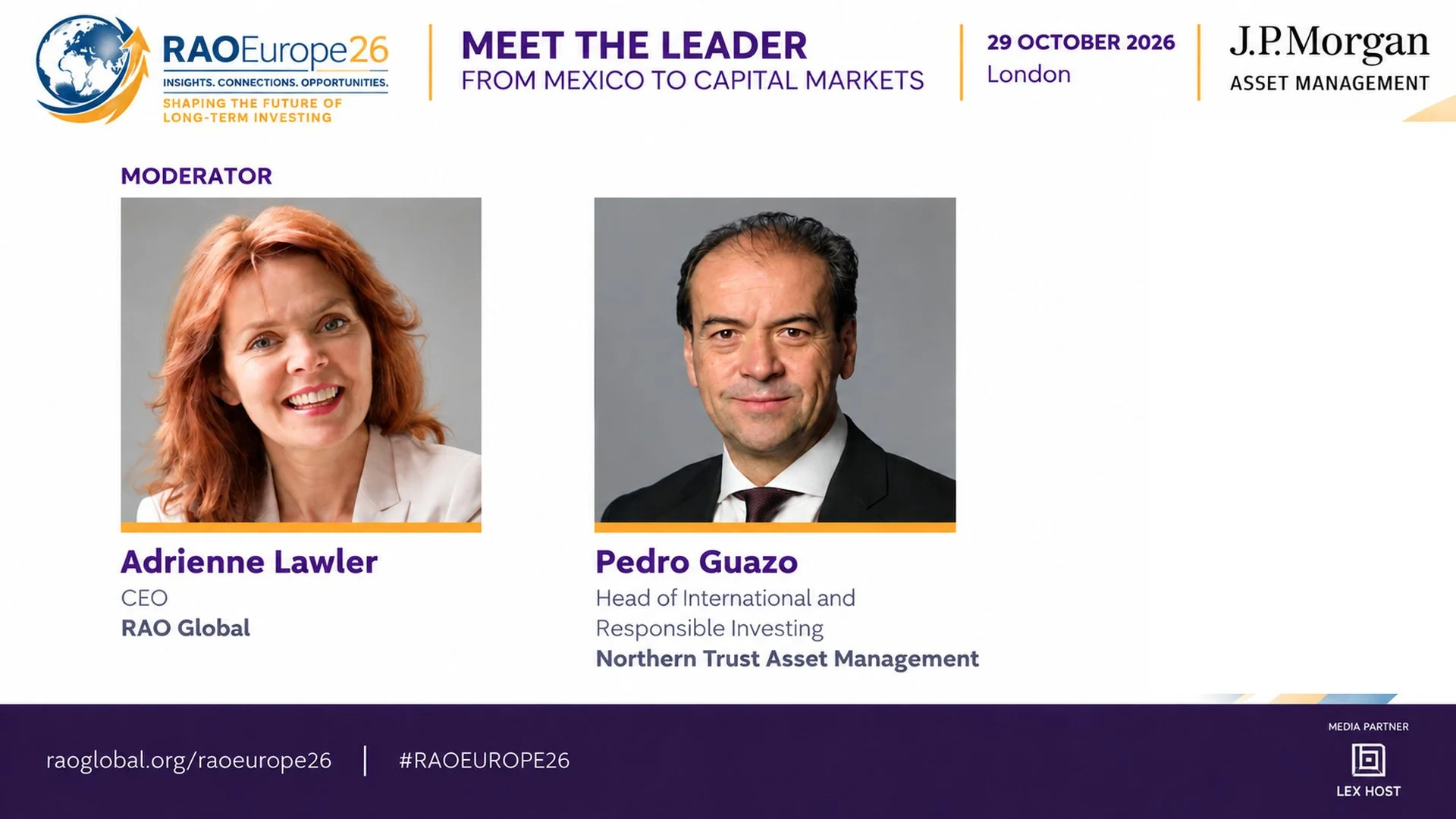
Pedro Guazo: leadership from both sides of the investment relationship
Few perspectives are better placed to illuminate this debate than that of Pedro Guazo, whose career spans senior investment leadership at the United Nations Joint Staff Pension Fund and his current responsibilities at Northern Trust Asset Management.
During his Meet the Leader conversation at RAOEurope26, Guazo's experience provides an opportunity to examine how institutional investment priorities are changing — and what responsible leadership means when decisions must withstand scrutiny over decades.
What lessons from managing institutional capital should investment managers take more seriously?
How can stewardship, innovation and financial performance reinforce one another without compromising fiduciary discipline?
And what distinguishes investment organisations capable of creating genuine long-term value from those simply responding to prevailing market sentiment?
These are not theoretical questions. They influence manager selection, portfolio construction, governance and ultimately the financial security of beneficiaries.
Beyond labels, towards lasting value
The next chapter of responsible investment may be defined less by the terminology institutions adopt than by the evidence they produce.
Sustainability, stewardship and stakeholder value will remain contested concepts. But the underlying investment questions are becoming harder to avoid.
How do businesses sustain competitive advantage? What makes portfolios resilient? Which risks are markets failing to price? And how should institutional capital respond?
Northern Trust's research offers one possible approach. Europe's changing regulatory and stewardship landscape provides another perspective.
Together, they point towards a broader reassessment of how long-term investment value is understood, measured and delivered.
At RAOEurope26, hosted by J.P. Morgan in London on 29 October, Pedro Guazo's conversation will contribute to that debate within the wider conference theme, Capital Allocation in an Age of Fragmentation.
The defining question is no longer simply whether investors should consider stakeholder value.
It is whether they can demonstrate that doing so creates better investment decisions, stronger institutions and more resilient long-term returns.